
Textile Care Guide
Discover the best ways to protect and handle fabrics for lasting quality with Miele.
Cotton
Cotton is one of the most popular natural fibres because it has excellent spinning characteristics and is particularly long-wearing. There are more than 300 species of this shrub-like plant. The largest growing areas are China (23%) and the USA (20%).
Washing: Miele provides a special "Cottons" programme for optimum care. White cotton generally withstands washing up to 95°C. On the other hand, coloured cotton should only be washed up to 60°C with a colour detergent due to the danger of fading. Do pay attention to the care label on the clothing as a matter of course.
Drying: Cotton can normally be dried in a tumble dryer. Miele dryers have a Cottons programme. Depending on the type of fabric please pay attention to the care instructions provided to prevent the risk of shrinkage.
Ironing: Cotton can be ironed with a hot iron (heat level 3) and with steam. Depending on the fabric, some garments should be ironed inside out.

Down
Down has plenty of volume, stores heat and provides insulation. This is why it is used for filling duvets and clothing. Although white down is the most expensive, there is no difference in quality between white and grey or mixed colour down.
Washing: Miele has developed special pillow and duvet programmes for the hygienic washing of down-filled items. High temperatures and a higher level of water effectively dislodge dust mites and dust mite faeces from the laundry.
Drying: Miele tumble dryers feature programmes for "Pillows" and "Large pillows". So your duvets and pillows are dried and plumped up optimally.
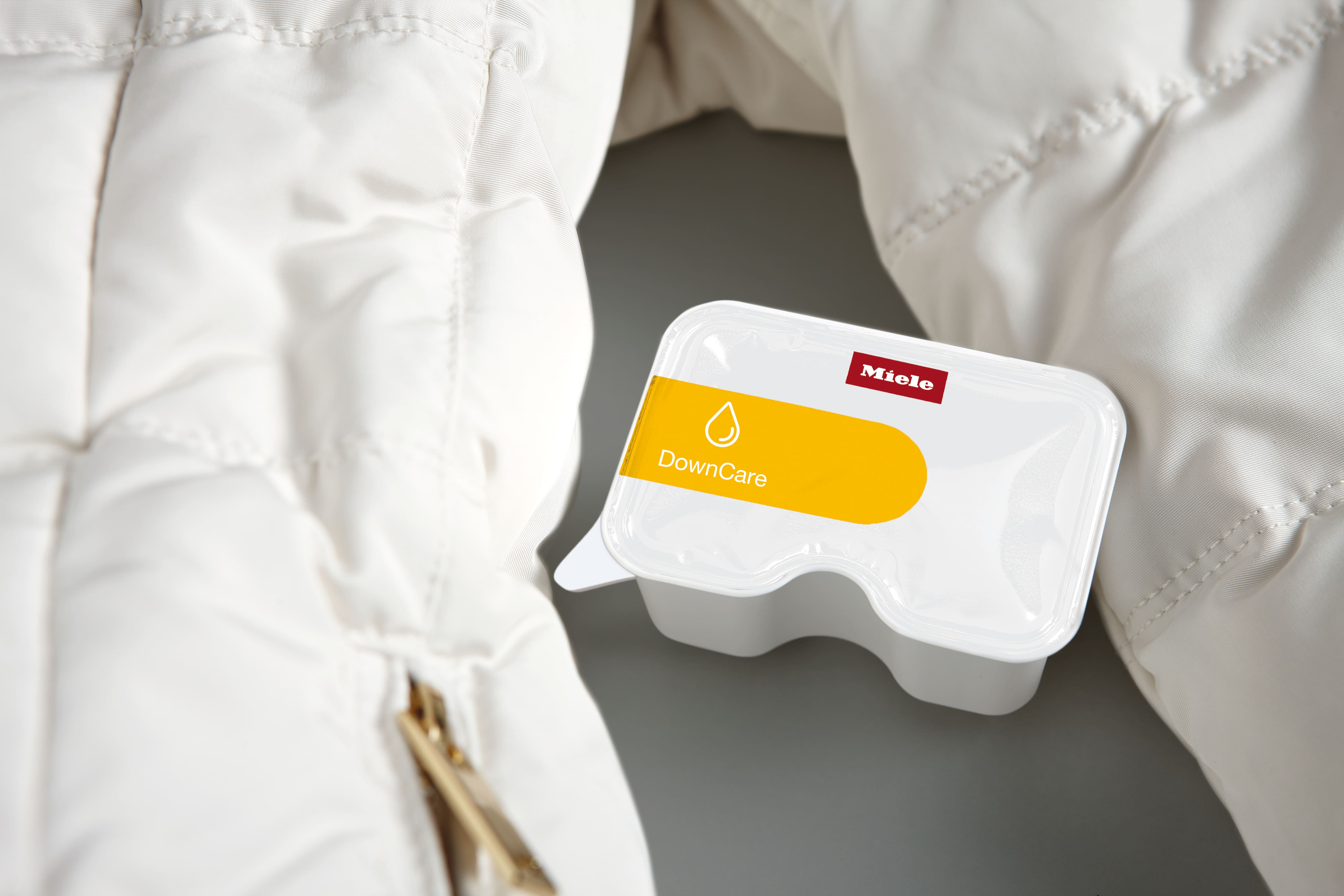
Extra tip: The special detergent "Down" from the Miele CareCollection ensures gentle and effective cleaning of jackets, sleeping bags, pillows and other down-filled items.
Terry towelling
Terrycloth is a looped fabric woven according to a specific pattern. Broadcloth terry products have a particularly high capacity for absorption due to their irregular loops.
Washing: Terrycloth is usually dyed to withstand washing in boiling water. Bathrobes only withstand washing up to 60°C. You should wash terrycloth towels separately the first two times at 60°C, because the release of excess dye is normal. Be aware that small loads of towelling can give off fluff.
Our recommendation: Wash new towelling in the biggest possible load.
Drying: Towelling quickly becomes hard when dried on a clothesline. This can be prevented by using a tumble dryer. Too much fabric conditioner can impair its absorbency. The honeycomb drum in our tumble dryers leaves your towels pleasantly fluffy even without fabric conditioner, because an air cushion is created by the honeycombed drum surface, which gently cushions the laundry.

Denim
Originally used for trousers for workers, denim is available today in the form of skirts, bags, shirts, jackets and numerous other items of clothing. The basis for the production of jeans is cotton. The twill weave of different colour threads (normally white and blue) creates the specific jeans pattern, where one side of the fabric has a blue sheen and the other side appears white.
Washing: In principle, denim should not be washed at temperatures hotter than 60°C, and stretch denim only at up to 30°C, using delicate detergent without optical brighteners. Turn your jeans and denim garments inside out before washing to avoid white stripes (whitening) during spinning. Denim should be spun at a reduced spin speed only. To avoid discolouration of other textiles, denim should be washed separately the first time. Miele provides a special Denim programme to care for your garments, in which the drum rhythm, water level and spin speed are adapted precisely to the requirements of the textile.
The result: Optimum wash results, very little creasing and gentle laundry care.
Drying: Miele tumble dryers also have a special Denim programme. The temperature management and specific drying levels developed for these textiles ensure that your favourite jeans fit perfectly even after drying.
Ironing: It is not absolutely essential to iron denim. However, to achieve a perfect ironing result set the temperature to high and use lots of steam.

Leather
Because genuine leather is an animal product, it requires special care. Each type of leather should be cared for differently. Therefore we recommend trying out care products on an inconspicuous spot. In principle, the following applies to all leather clothing: do not use any solvents or nail-polish remover.
Drying: Allow parts that have become wet to dry on a shaped hanger at room temperature (not in direct sunlight). Never hang leather clothing up in a wardrobe when it is wet (danger of mould).
Ironing: Leather is best ironed from the inside using heat level 1 and under tissue paper or a dry cloth. Steam should not be used.
Extra tip: Before wearing for the first time and to protect against moisture damage, spray the garment with a CFC-free leather waterproofing agent.

Linen
This natural fibre is gained from the stems of the flax plant. Linen is characterized by its high strength and durability. In addition, it is resistant to dirt and odours. It wrinkles easily because it does not stretch much.
Washing: White and bleached linen can be washed at temperatures up to max. 60°C, and coloured linen up to 40°C with detergent for delicates without brighteners. To check for colour fastness, place the corner of a garment between two layers of white fabric and iron using a hot steam iron. If the colour leaves an impression on the white fabric, the material loses colour. Linen wrinkles very easily and should be spun using a low spin speed in the washing machine, or not spun at all.
And take care: linen is very susceptible to mildew.
Drying: It is best to dry linen on the washing line. Pull into shape before hanging it up. Linen dries faster and easier if you slightly dry it in advance using Miele's special "Smoothing" programme. This reduces creasing and makes it easier to iron.
Ironing: Linen should be ironed with a hot iron (3 dots) and preferably with steam. An anti-stick sole provides additional protection against scorch marks.
Extra tip: Linen is easier to iron if you add rinsing starch before the last rinsing cycle.

Blended fabrics
A good fabric sometimes is like a good perfume: the blend makes the difference. Robust cotton becomes elegant through the addition of rayon. Cashmere becomes financially more affordable through the addition of cotton. Classic blended fabrics consist of a mixture of cotton and synthetic fibres.
Washing: To be on the safe side, use the Miele automatic programme for mixed loads of cotton and easy-care laundry. A sensor determines the current load situation using a clever technical procedure, and the electronics adapt the programme cycle to suit the load.
Drying: We also recommend the Miele automatic programme for gentle drying.
Ironing: You should always iron mixed fabrics at the temperature suited to the most sensitive fibre in the blend. For example, you would only iron a linen-viscose blend using the lower temperature suitable for viscose.

Silk
Silk is a natural fibre obtained from unwinding silkworm cocoons. Hard-working silkworms spin the fine threads, up to four kilometres in length. Thanks to its unmistakable softness and appearance, silk offers a touch of luxury when close to the skin.
Washing: Miele has made hand washing silk a thing of the past. The Miele "Silks" programme ensures particularly gentle cleaning of all hand-washable, delicate textiles that do not contain any wool. The wash process is adapted perfectly to care for silk. In addition to this, the Miele honeycomb drum is especially easy on your laundry thanks to its honeycombed surface structure.
Drying: The "Silks handcare" programme in Miele tumble dryers airs the silk in a warm air flow and reduces formation of creases.
Ironing: Because the fibres are sensitive to high temperatures, silk should be ironed in a still slightly moist state at max. 2 points or with steam. An anti-stick sole provides additional protection against scorch marks.

Synthetic fibres
These fully synthetic fibres are extremely elastic and resistant to tearing and abrasion. They do not shrink and dry quickly since they absorb little moisture. Synthetic textiles also maintain their shape well and do not wrinkle.
Washing: To avoid the danger of thermosetting of creases, polyester and polyamide should be washed at a maximum of 60°C using a "Minimum iron" or "Delicates" programme. Many Miele washing machines even have a special programme for optimum care of synthetic fabrics. If you use fabric conditioner, you can prevent synthetic fibres from building up electrostatic charges and static cling.
Drying: Synthetic fabrics are treated especially gently in a Miele tumble dryer thanks to the "Delicates" programme. However, it often suffices to roll the textiles into a towel and press out the moisture. The remaining moisture evaporates just as quickly if the fabric is laid down somewhere or hung on a hanger.
Ironing: Nylon fibres tend to contract if subjected to substantial heat. Polyester has good properties for eliminating wrinkles, so that it tends not to crease very much. If creases develop during washing or drying, you can simply smooth them out with your hand. Especially stubborn wrinkles disappear if you iron them using heat level 1. An anti-stick sole provides additional protection against scorch marks.

Wool & Co (alpaca, cashmere, mohair etc.)
Not all wool is the same – especially when worn next to the skin: the finer and longer wool fibres are, the fluffier they feel. Only short, thicker fibres can scratch uncomfortably.
The finest wool comes from merino sheep. The very fine, crimped fibres are mostly used to make high-quality outerwear.
Also very noble: cashmere. High-quality cashmere is obtained by combing out the fur of the cashmere goat and is therefore correspondingly expensive. Cashmere is often mixed with wool.
In addition to cashmere, the so-called fine hairs also include alpaca, vicuña and mohair.
Tip: For wool, you should not use a full or colour detergent. These work with a higher pH value - this would lead to shrinkage and felting of the wool textiles.

Washing: You can wash wool with a clear conscience: Your high-quality and delicate textiles are gently cared for in Miele's handwash wool programme.
Detergent: Miele WoolCare uses special wheat protein to gently clean and care for delicate wool fibres.
Drying: Textiles become noticeably fluffy after washing with the Finish Wool programme on Miele tumble dryers. Then leave your woollen laundry to air dry for a while - and you're done.
Ironing: With the Miele FashionMaster, you can get long-fibred woollen jumpers extra fluffy again. Simply set the rotary selector to the medium temperature setting, attach the non-stick soleplate, activate the inflation function and gently run the iron and a little steam over the fabric.

