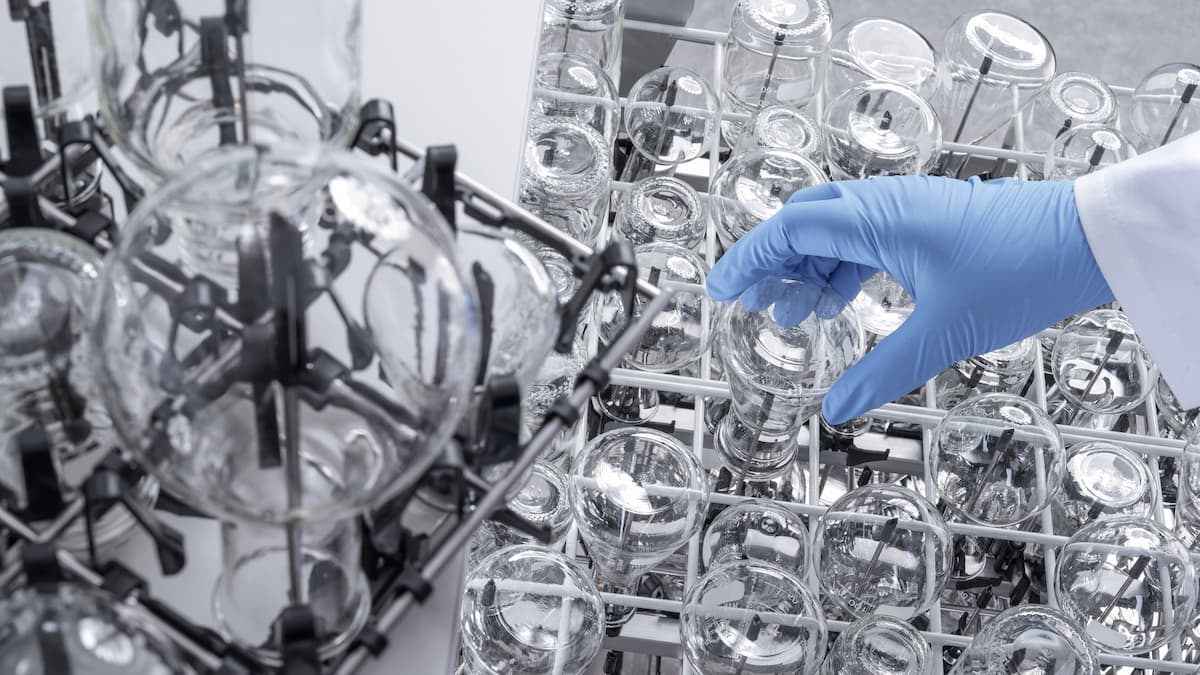
Compare all our glassware washers for labs of all kinds and sizes
We offer the best laboratory glassware washers for your individual requirements – from the entry-level ExploreLine machine to compact undercounter washers from the ExpertLine range, to space-saving SlimLine machines and large-chamber lab washers.
Why choose a lab glassware washer from Miele Professional?
Our glassware washers ensure top-class cleaning results combined with optimum protection of lab glasses. Automated programme cycles reduce the amount of work involved and save time. High capacities together with special-purpose cycles ensure the efficient use of resources and excellent cost-efficiency.

Our programmes are designed to ensure analytical cleanliness while saving on detergents and resources.

Our EasyLoad accessory system ensures quick and easy loading of any laboratory glassware, offering the right solution for every lab.

Tested for 15,000 operating hours and at least 15-year availability of spare parts – ensuring that repairs can be carried out even after the machine has been discontinued.
Which laboratory glassware washer is right for you?
|
ExploreLine PLW 8604 |
ExpertLine PLW 8683, PLW 8693, PLW 8683 CD |
ExpertLine PLW 8636 |
SlimLine PLW 7111 |
PLW 8615, PLW 8616, PLW 8617 large-chamber laboratory washer |
|
|---|---|---|---|---|---|
| Chamber volume in l | 145 | 145 | 146 | 241 | 351 |
| Machine size in mm (external dimensions H, W, D) | 835 / 600 / 600 | 835 / 600 and 900 / 600–700 | 1430 / 900 / 700 | 1940 / 650 / 700 | 2495 / 900 and 1150 / 990 |
| Loading levels | 2 | 2 | 2 | 3 | 3 |
| No. of programmes | 6 | 19 | 24 | 23 | 30 |
| Free programme slots | 4 | 10 | 50 | 20 | 170 |
| Freely programmable | (particularly extensive) | ||||
| Shortest programme running time in min | 19¹ | PLW 8683: 20² / PLW 8693 and PLW 8683 CD: 55³ | 62³ | 52³ | 47³ |
| Control | 3" touch display | 4.2" colour touch display | 7" colour touch display (PLC) | 7" colour touch display | 7" colour touch display |
| Max. temperature | 70 °C | 93 °C | 93 °C | 93 °C | 93 °C |
| Max. number of EasyLoad injector modules | 2 | 4 | 4 | 6 | 9 |
| Cleaning pipettes | |||||
| Drying | PLW 8683: EcoDry drying assistance with Auto Open / PLW 8693, 8683 CD: DryPlus hot air drying with HEPA filter | DryPlus hot air drying with HEPA filter | Hot air drying with HEPA filter | Hot air drying with HEPA filter | |
| Capacity for 100 ml lab glasses | 64 plus beakers | 128 | 128 | 192 | 324 |
| Capacity for 250 ml lab glasses | 36 plus beakers | 72 | 72 | 108 | 180 |
| Capacity for 1000 ml lab glasses | 16 | 16 | 16 | 32 | 60 |
| Capacity for pipettes | - | 98 | 98 | 98 | 294 |
| Capacity for vials | 196 | 196 | 196 | 294 | 588 |
| Water consumption per cycle in the Standard programme | 27 | 37.5 | 71 | 78 | 123 |
| Connection types (cold, hot, demineralised water) | Cold, hot, demineralised water | Cold, hot, demineralised water | Cold, hot, demineralised water | Cold, hot, demineralised water | Cold, hot, demineralised water |
| Connectivity / Miele MOVE Connect | WiFi / Yes | WiFi, Ethernet (optional) / Yes | Ethernet / No | WiFi, Ethernet, USB / Yes | Ethernet, USB / No |
| Max. number of dispensing pumps | 1 | 3 | 4 | 4 | 6 |
| Integrated pre-heating tank | Depending on model | Depending on model | |||
| Status display via wash cabinet lighting | |||||
| Conductivity monitoring | - | PLW 8383: – / PLW 8693: depending on model / PLW 8683 CD: standard | Depending on model | Depending on model | Standard |
| Door type | Stainless steel hinged door | Stainless steel hinged door / glazed hinged door | Stainless steel hinged door | Glazed hinged door | Glass vertical sliding door plus double door option |
| Casing | Stainless steel / lotus white | Stainless steel / lotus white | Stainless steel | Stainless steel | Stainless steel |
| Installation type | Freestanding machine / undercounter | Freestanding machine / undercounter | Freestanding machine | Freestanding machine | Freestanding machine |
| Go to products | Go to products | Go to products | Go to products | Go to products |
FAQ: Your frequently asked questions about cleaning lab glasses with a glassware washer
Thinking of buying a laboratory glassware washer or automating existing processes in your lab? In our FAQ section you will find answers to the most frequently asked questions about the selection, use and maintenance of lab glasswashers. From suitable detergents and technical requirements to differences compared to manual cleaning – this section provides compact and easily understandable information to help you make your decision. Ideal for laboratories in education, research, industry, medicine or pharmaceutics.
Domestic dishwashers are specially designed for cleaning crockery and cutlery. Their programmes are designed to remove food residues. The parameters used – such as wash pressure, temperature and activation time – are not tailored to the requirements of laboratory glassware. Dishwashers are not specifically intended for contaminated or particularly delicate glassware. In addition, the materials of the wash baskets are not resistant to aggressive laboratory chemicals and can therefore be damaged. Narrow-volume glassware cannot be reliably cleaned with dishwashers either, as conventional baskets do not have injector nozzles that specifically clean the inner surfaces of the laboratory glassware. In addition, the baskets do not provide a secure hold for the different types of lab glasses and the capacity cannot be optimally utilised.
A laboratory dishwasher is specially designed for cleaning sensitive laboratory glassware. Unlike domestic dishwashers, it offers:
- Analytically pure cleaning without residue thanks to optimised programmes and suitable baskets and inserts with injector nozzles
- Hollow item cleaning for complex glass shapes
- Thermal and chemical disinfection programmes
- Compatibility with demineralised water and laboratory detergents
- Short running times and resource-saving technologies
Laboratory glassware washers should only be operated with special lab detergents that leave no residues and guarantee analytical cleanliness. This includes:
- Alkaline cleaning agents for organic residues
- Acidic neutralising agents for removing limescale
- Surfactant-free products to avoid contamination
Our ProCare Lab detergents are optimally matched to our glassware washers and their programmes.
The service intervals depend on the degree of usage. In general:
- Regular visual inspection of the spray arms and filters
- Annual maintenance by qualified personnel recommended
- Documentation of maintenance for quality management purposes (e.g. ISO, GLP)
We are happy to support you in this regard with our PROtect service solutions.
“Analytically pure” means that the cleaned laboratory glassware is free of organic, inorganic and microbial residues. This is essential for:
- Reliable measurement results
- Avoidance of cross-contamination
- Quality-assured laboratory processes
Hollow items are cleaned using special load carriers with direct water supply into narrow glass structures such as volumetric flasks or pipettes. In the process:
- Pressure-controlled rinsing water is channelled through nozzles
- Interior and exterior cleaning is carried out simultaneously
- Residue-free drying is supported by HEPA-filtered air
Our EasyLoad accessory system provides simple, safe and fast support.
The choice of load carrier depends on the type and size of the glassware. We offer:
- EasyLoad as our flexible and modular loading system
- Special carriers for hollow items, Petri dishes, test tubes
Please contact us and we will put together a suitable accessory set for your individual requirements.
The duration varies depending on the programme, machine and type of drying.
In some machines, a quick programme is completed in around 20 minutes. The more intensive the cleaning and drying, the longer the duration of the programme. Universal and standard programmes with hot air drying have running times of around one hour.
In addition, you can also programme your own programmes in many of our machines.
Automatic cleaning with a laboratory glassware washer offers numerous advantages over manual cleaning:
- Reproducible cleaning results: automatic special programmes ensure consistent quality – regardless of personnel.
- Increased safety: a laboratory glassware washer reduces the risk of glass breakage and injuries caused by manual washing or contact with chemicals.
- Time saving: cleaning with a laboratory glassware washer saves valuable working time, especially if there are large volumes of items requiring cleaning.
- Gentler on the glassware: the contact times with the cleaning agent are short and precisely controlled.
- Analytically pure cleaning: minimises contamination through standardised processes and controlled washing parameters.
- Sustainable: saves valuable resources such as energy, water and detergents.
- Documentation and traceability: many laboratory glassware washers offer digital logging for GLP and ISO requirements.
In contrast to this is manual cleaning:
- Time-consuming
- Prone to errors
- More expensive in the long term due to faster glass wear, higher glass breakage and labour costs
- Difficult to document
- Often insufficient for demanding analytical applications
- 1.without drying
- 2.plus drying time in the context of EcoDry
- 3.incl. drying time with hot air drying